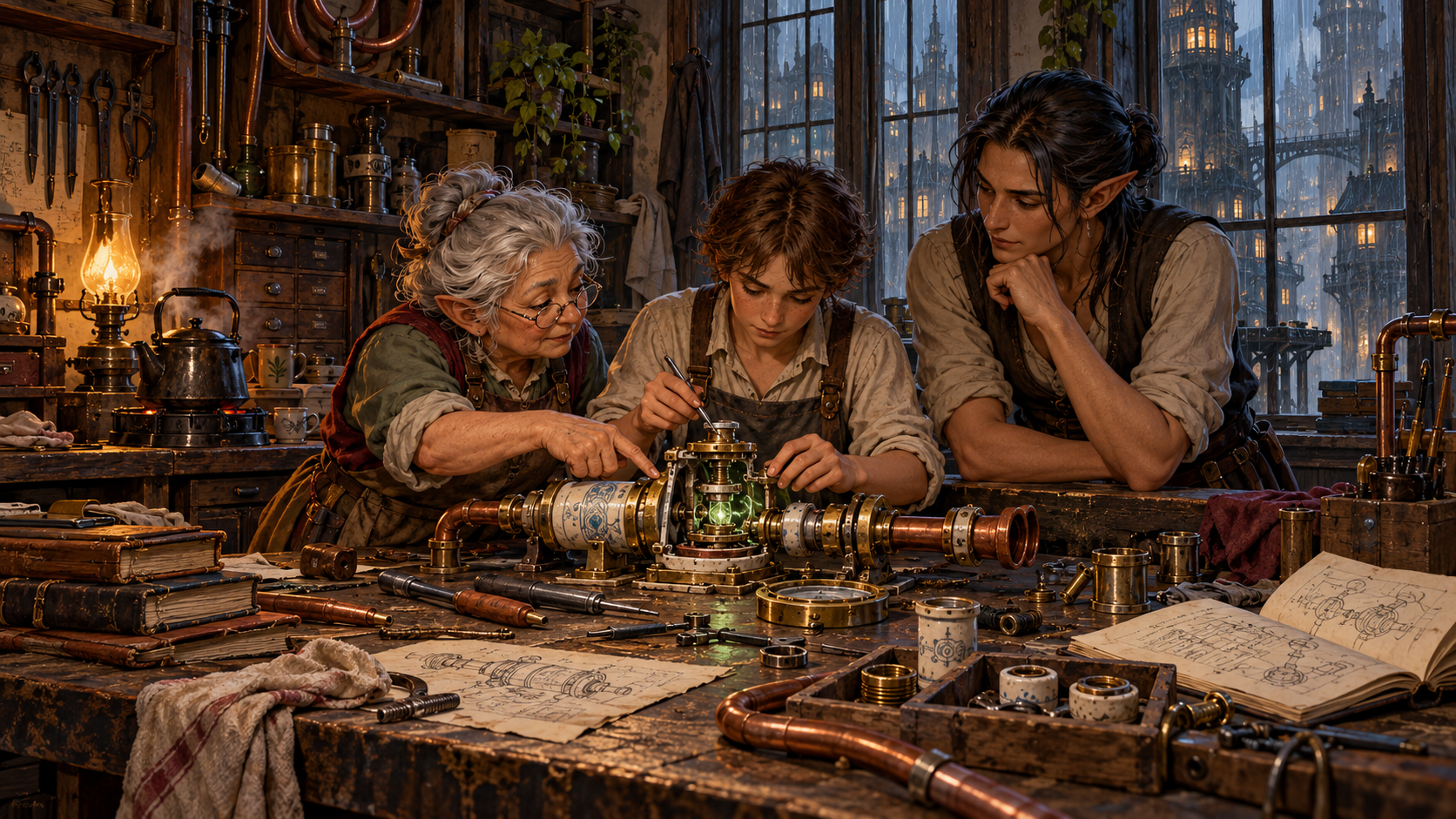
A repair lesson in a Sharn workshop: the learner works the mechanism while an experienced craftswoman explains its parts.
The name Free Weave surfaces in arguments about who is allowed to teach magic, repair enchanted equipment, and decide what knowledge belongs behind a House counter. Those who speak in its favor hold that people should be free to study and use magic without a provider's continuing permission. They dispute the use of the Mourning to justify restrictions on independent discovery: its cause remains unknown, while the restrictions reliably preserve House authority and income.
The name offers little certainty about a particular person. An independent repairer may have no connection to the Free Weave. Someone who quietly passes on a useful technique may have one they will never discuss with a customer.
Magic people can maintain
An enchanted pump is useful only while someone can keep it working. A household may own its equipment and still depend on a certified repairer, restricted replacement parts, or recurring authorization. The Standard and Weavegrid connect those arrangements across much of Sharn.
The work associated with the Free Weave addresses that dependence directly: practical lessons, shared repair knowledge, independently maintained devices, and copies of research that its owners would rather keep restricted. A repair that leaves its owner able to repeat the work matters as much as the immediate saving. Teaching can keep a whole landing from depending on one specialist.
Useful magic still needs skilled hands, suitable materials, and care. The Free Weave's argument is that those skills should be taught and examined openly, rather than made conditional on House approval. Personal cantrips are legal; commercial spellwork and alterations to certified devices face permits, inspections, and uneven enforcement. A technically sound repair can still put its maker or customer in legal difficulty.
Quiet assistance
For most residents, contact begins with a person rather than an organization. A neighbor recommends someone who can explain a repair. A tutor takes a learner whom an approved apprenticeship would exclude. A workshop lends a tool and asks for help carrying supplies later.
Such assistance does not establish membership, and receiving it does not oblige someone to join a cause. Asking around for a list of Free Weave members is unlikely to win confidence. People who risk their employment or workshop by helping others have reasons to be careful about introductions.
The Landing Compact also supports shared tools and independent services. Its household and labor concerns overlap with the Free Weave's emphasis on magical knowledge, but the names do not describe a single organization.
Who gets to learn
The beliefs attributed to the Free Weave put conduct ahead of ancestry. A dragonmark does not make someone the rightful owner of other people's knowledge; it need not prevent them from sharing their own. Nor does earning a living at a House desk or workshop tell a neighbor everything about a person's loyalties.
That position can be hard to sustain in a city where access is so unequal. Some opponents of House control distrust anyone still drawing a House wage. Others point out how few residents can afford to leave their work, and judge them by the help they actually give.
Freedom and its consequences
A household can welcome a cheaper repair and refuse an unauthorized alteration. It may have children to house, a lease to protect, or no means of surviving a service dispute. Freedom to use magic has little meaning if someone else decides which risks a resident must accept.
Accounts of the Free Weave differ most sharply here. Admirers describe patient teachers and people who share skills without making themselves indispensable. Critics describe enthusiasts who assume that a useful result excuses acting without permission. Anyone offered help has reason to ask what will change, what could fail, and who will remain to help if an inspector comes calling.