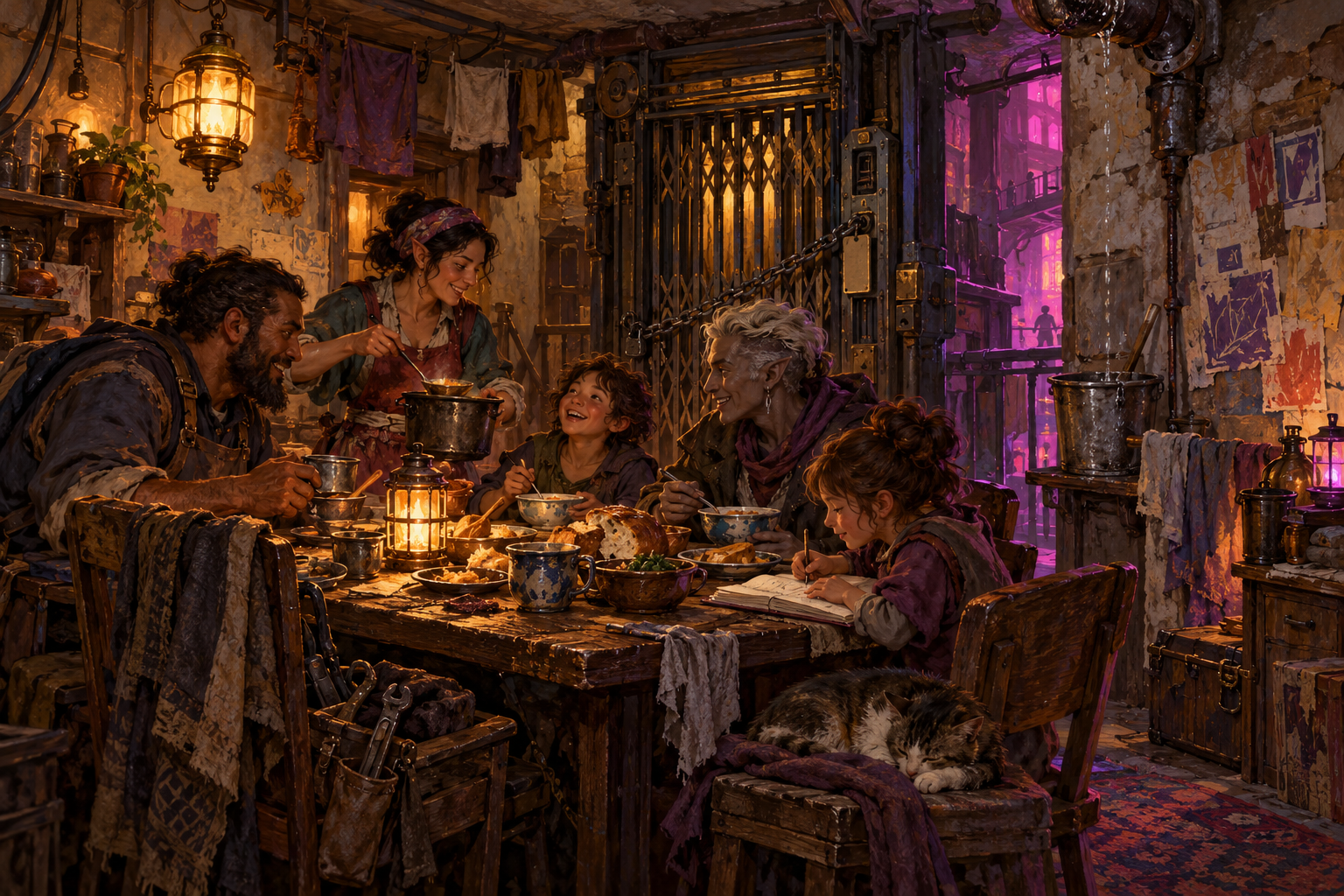
Neighbors share supper beside a stopped lift on a worn lower-ward landing.
Sharn is a city of bridges, platforms, lifts, skycoaches, enclosed streets, and older passages beneath. Height often follows wealth. A person can pass from a polished concourse to a neglected service landing without leaving the same tower.
| Layer | Everyday surroundings |
|---|---|
| Skyway and upper wards | Open views, staffed doors, private terraces, and premium care; servants and delivery workers share these spaces with wealthy residents |
| Middle wards | Shops, markets, stations, offices, skilled work, students, and long commutes |
| Lower wards | Close housing, shared facilities, small businesses, neighborhood casters, congregations, and mutual aid |
| Depths | Old stone, uncertain rights of way, scavengers, explorers, squatters, and people priced out of lawful space |
On the landings
A landing table can hold yesterday's stew, a spare coat, three borrowed tools, and a note asking who can accompany a neighbor to court. Repair circles keep equipment working. Practical-magic lessons pass useful skills between households. The Race of Eight Winds gives people something to celebrate together.
Congregations, legal clinics, independent inns, and healers offer what they can. Their resources are limited, and generosity can meet selective enforcement: inspectors break up a potluck under food-distribution rules while a licensed vendor keeps serving nearby.
Residents of a neglected tower still cook, argue, work, celebrate, and look after one another. The failed lift is one part of their neighborhood.
Two Sharn mornings
Nera Vale repairs lift fixtures for a contractor, rents most of her tools, and queues for a shared washroom. A shift-change slip reaches the message room with yesterday's seal. She misses an hour of work; the foreman says she should have checked earlier. Her transit credential gets her through the hub, and breakfast costs a few copper pieces.
Later she lends a neighbor a wrench and promises onions for the landing meal. At home, the lift is closed. The landlord says the House service crew is coming. Nera takes the stairs; the rent notice will still be waiting beside the message slots.
Above the clouds, Dalen ir'Voss receives his appointments from a private Sivis courier over breakfast. A skycoach waits at his terrace, its route already arranged by household staff. At the office, a Kundarak statement includes a dinner he barely remembers. Paying it leaves the week's plans intact.
When his daughter develops a fever, the family's alert brings a Jorasco clinician before dusk. He listens closely to the diagnosis. The public clinic queue has never been part of his experience.
These mornings belong to the same city. The differences lie in time, distance, reliable service, and how much one unexpected bill can change.
Signs and advertisements
In 1250, magical advertising is part of Sharn's everyday streetscape. Illuminated signs, repeating illusions, and projected House emblems compete with the signs of small shops, food stalls, repairers, and neighborhood services. The Houses use modern commercial logos descended from their ancestral heraldry.
Advertising is more common and glaring on the lower levels: bright signs crowd shopfronts, landings, and routes through the towers. Local businesses share that visual space with large House campaigns. Above them, upper-ward advertisements remain present but are fewer and more restrained. Wealthy districts and Skyway favor subtle branding: discreet illuminated names, refined emblems, and carefully placed displays rather than a wall of competing light.
The contrast follows the city's unequal access to space and comfort. Modern commerce inhabits Sharn's stone towers, bridges, and magical infrastructure at every height.
Sources & adaptation
- Mana Standard Player Primer — PDF pages 3-6