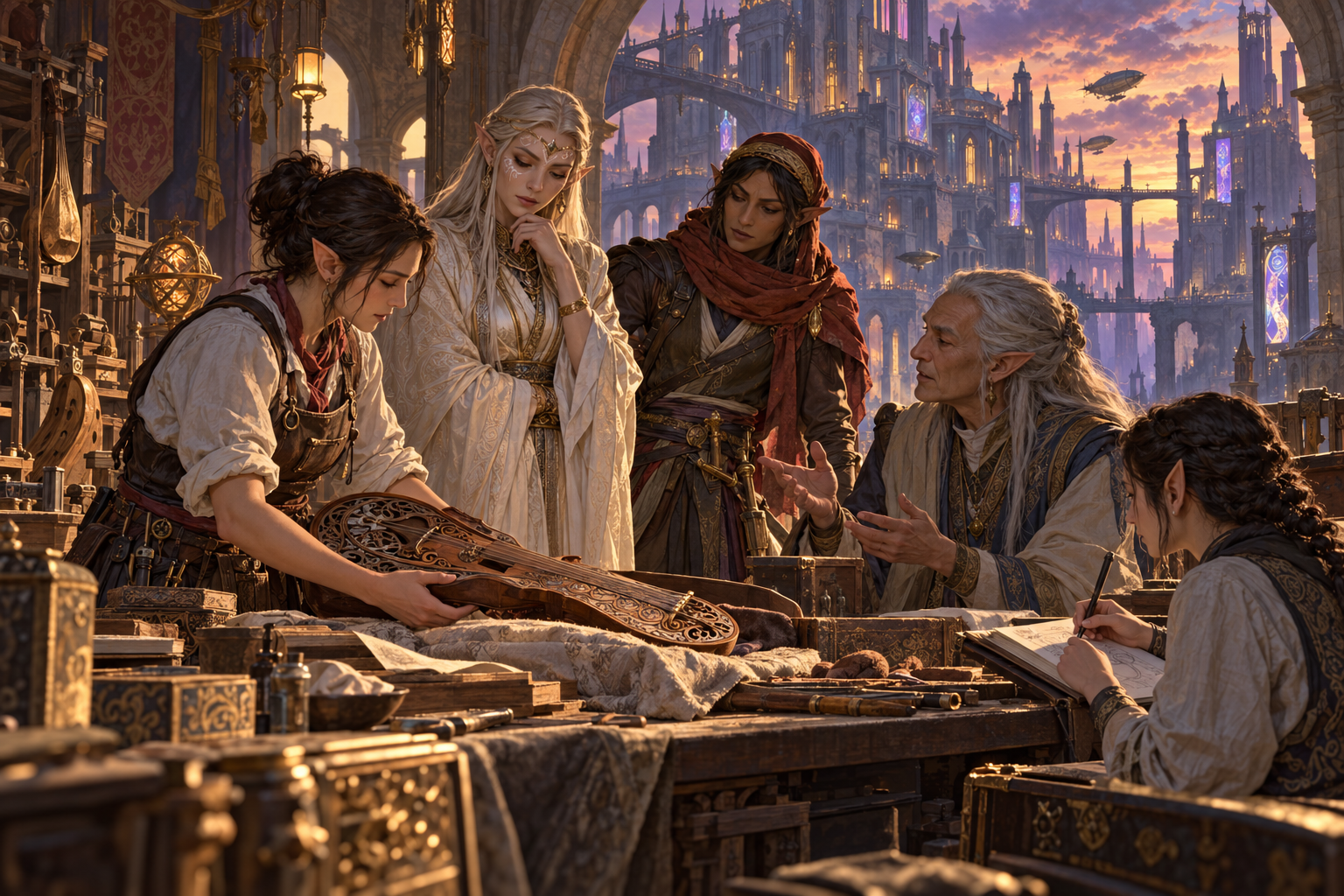
Elven visitors and Sharn residents study an old crafted object above a changing city.
Elven cultures in Eberron take strikingly different approaches to ancestry and memory. The island of Aerenal, the Tairnadal warrior tradition, and the long-established elven communities of Khorvaire all have their own histories. Long life allows customs and grievances to travel unusually far through a family, but it also leaves ample time for an individual to change.
Three broad traditions
In Aerenal, reverence for ancestors shapes learning, artistic achievement, and religion. The deathless of the Undying Court are central to Aereni life: honored ancestors sustained through a distinct form of positive-energy existence. Aereni traditions prize the patient refinement of skills and the achievements worthy of being remembered.
The Tairnadal, closely associated with Valenar, honor ancestral heroes by emulating their deeds. A patron ancestor is a model of action and responsibility. That relationship is different from Aerenal’s institutional preservation of its honored dead.
Khorvaire’s elves have lived among other peoples for many generations. Their national loyalties, trades, and religious practices can be those of Breland or another local community. An elf’s birthplace and chosen life can matter more than the traditions of either overseas homeland.
Lives measured in centuries
 Art: Kalman Andrasofszky. Image source and credits, Eberron Wiki.

In Sharn in 1250, an older elf may remember the Last War as lived experience while a human neighbor knows it through grandparents’ stories. The same interval can mean a single adult life in one household and several generations in another. Memory is personal: living through an event does not give someone access to every council chamber, battle, or hidden decision behind it.
Phiarlan and Thuranni carry the Mark of Shadow in elven families. Their prominence in the arts gives them a recognizable public presence. The Houses encompass only part of elven society; artists, laborers, tenants, clergy, and independent professionals have lives outside those lineages.
Background: Elves of Eberron.
Ancestors and daily obligations
Aereni reverence for the dead reaches into practical life. Honored ancestors can remain teachers, judges, and sources of counsel. The Undying Court depends on positive energy and the devotion of the living; it is distinct from undead beings sustained by consuming life. Most Aereni do not become deathless. Preservation is an honor rather than an automatic consequence of ancestry.
An Aereni craftsperson may spend decades refining an inherited technique. A Tairnadal warrior instead seeks deeds through which a patron ancestor's example can live again. These traditions can produce disagreements about what honoring the past requires. A Khorvaire elf can respect either tradition, reject it, or know it chiefly through stories.
Beyond those traditions
Drow are another elven people, strongly associated with Xen'drik across the sea. Their communities have their own histories, faiths, and approaches to magic. They are not a branch of the Undying Court, and a dark complexion does not identify someone's culture or allegiance.
Additional cultural reference: Exploring Eberron, Elves of Aerenal, especially printed page 37.
Sources & adaptation
- Sidebar: Elves of Eberron — Keith Baker — Cultural distinctions
- Wayfinder’s Guide to Eberron — Ch. 3: Elves