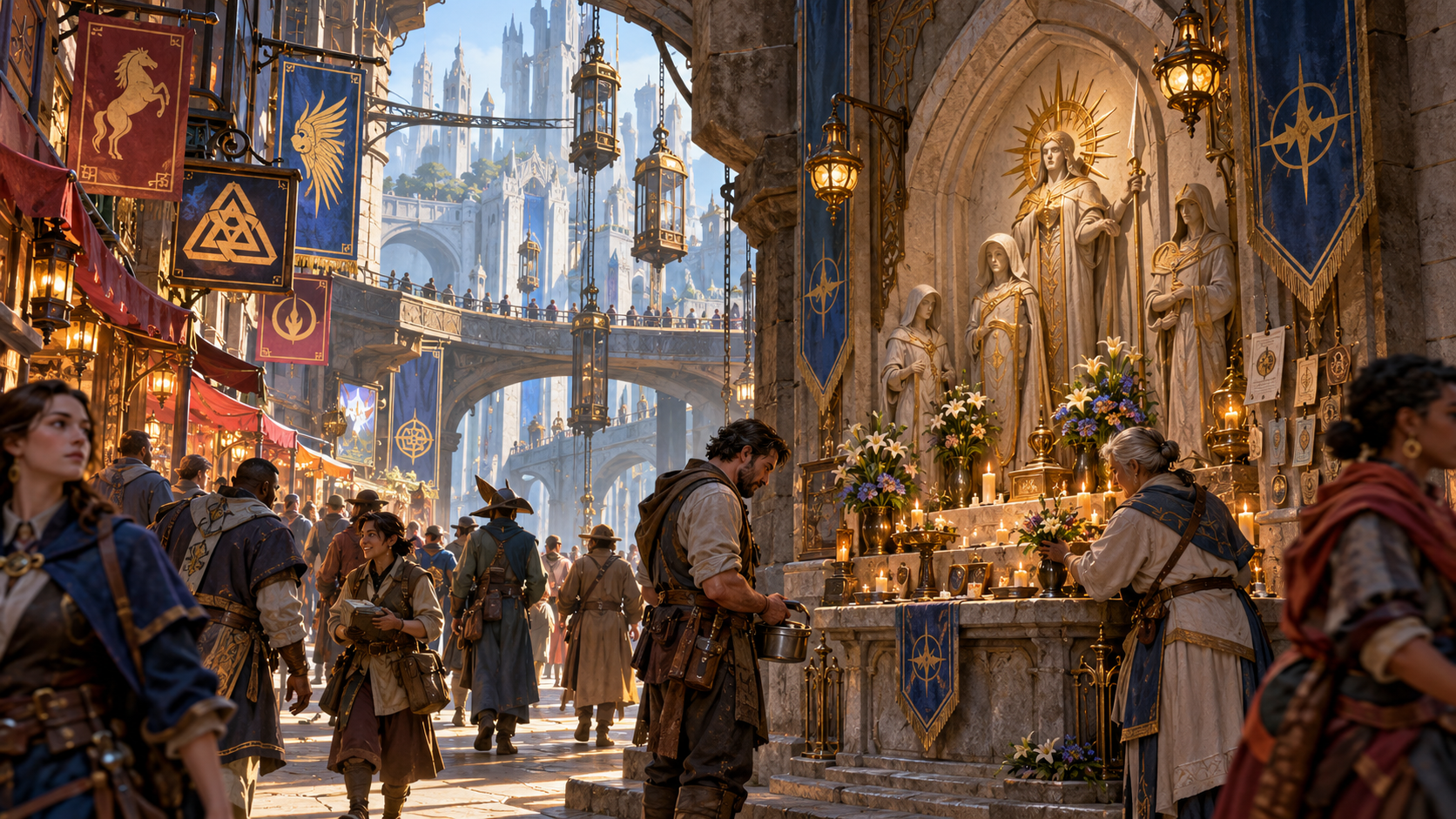
A worker pauses at a wayside shrine while the surrounding passage carries on with its day.
Faith in Sharn appears in everyday life: a blessing before work, a family funeral, a shrine beside a busy route, or a congregation trying to feed more people than its stores can support. A priest may perform real magic without settling every question about the gods, death, or the right way to live.
The Sovereign Host
Followers of the Sovereign Host honor divine powers present in the activities of life. A smith may invoke Onatar at the forge, a teacher Aureon, a merchant Kol Korran, and a household Boldrei. Worship often embraces the Host together rather than choosing one deity and rejecting the others. Names, blessings, and symbols are familiar even to many people who are not devout.
The Dark Six belong to the same broad religious tradition but concern feared, dangerous, or rejected forces. Their worship varies. A person acknowledging a dangerous power and a group committing harm in its name do not represent the same relationship to it.
The other Sovereigns are Arawai of fields and growth, Balinor of the hunt, Dol Arrah of honor and wise conflict, Dol Dorn of strength and battle, and Olladra of good fortune. Together with Aureon, Boldrei, Kol Korran, and Onatar, they form the Nine. A household can honor different Sovereigns at different moments of the same day.
The Six are the Devourer, Fury, Keeper, Mockery, Shadow, and Traveler. Their names evoke dangerous nature, overwhelming passion, grasping possession, treacherous conflict, forbidden magical knowledge, and disruptive change. Interpretations differ: a people revering the Shadow as the giver of their gifts can view that power very differently from a Brelish priest warning against it.
The Silver Flame
 Art: Lee Moyer. Image source and credits, Eberron Wiki. Symbol of the Sovereign Host.

The Silver Flame is understood as a protective spiritual force, not a humanoid god presiding over one trade or nation. Its followers teach that mortals must stand together against supernatural evil. Couatls, celestial beings depicted as feathered serpents, are familiar emissaries in its religious imagery; the story of Tira Miron, guided by a couatl, is central to the Church's tradition.
The Church has a particularly strong historical connection with Thrane, but the faith crosses national borders. A Brelish follower need not place Thrane's government above their own community. A templar's duty to protect people is also different from an official's interest in preserving an institution.
Other paths
| Tradition | Central concerns |
|---|---|
| Silver Flame | Protecting people from supernatural evil and finding strength in a shared cause |
| Blood of Vol | The divinity within mortal life, the tragedy of death, and mutual support among Seekers |
| Gatekeepers | Preserving the natural world against dangerous extraplanar influences |
| Aereni ancestor veneration | Honoring ancestors as a continuing source of guidance and identity |
| Path of Light | A spiritual tradition associated with kalashtar, though not determined by ancestry |
Congregations in 1250 YK
Local clergy and congregations provide strained food, shelter, and care. A religious institution's public position can differ from the choices of an individual priest or believer. The ability to heal also depends on training, resources, and the limits of the magic available.
The gods and ultimate afterlife remain matters of faith. A miracle demonstrates that something happened; believers can still disagree about its meaning. Care, money, and housing describes where religious help fits among the city's other options.
Sources: Keith Baker, Selling the Sovereigns; Couatls and the Silver Flame; Sovereign Host; Dark Six.
Sources & adaptation
- Dragonmarks 4/11: Religion, Faith and Souls — Keith Baker — Religion, faith, souls, and certainty
- Mana Standard Player Primer — PDF pages 2-7, campaign-era additions
- Wayfinder’s Guide to Eberron — Ch. 2: Faiths of Khorvaire