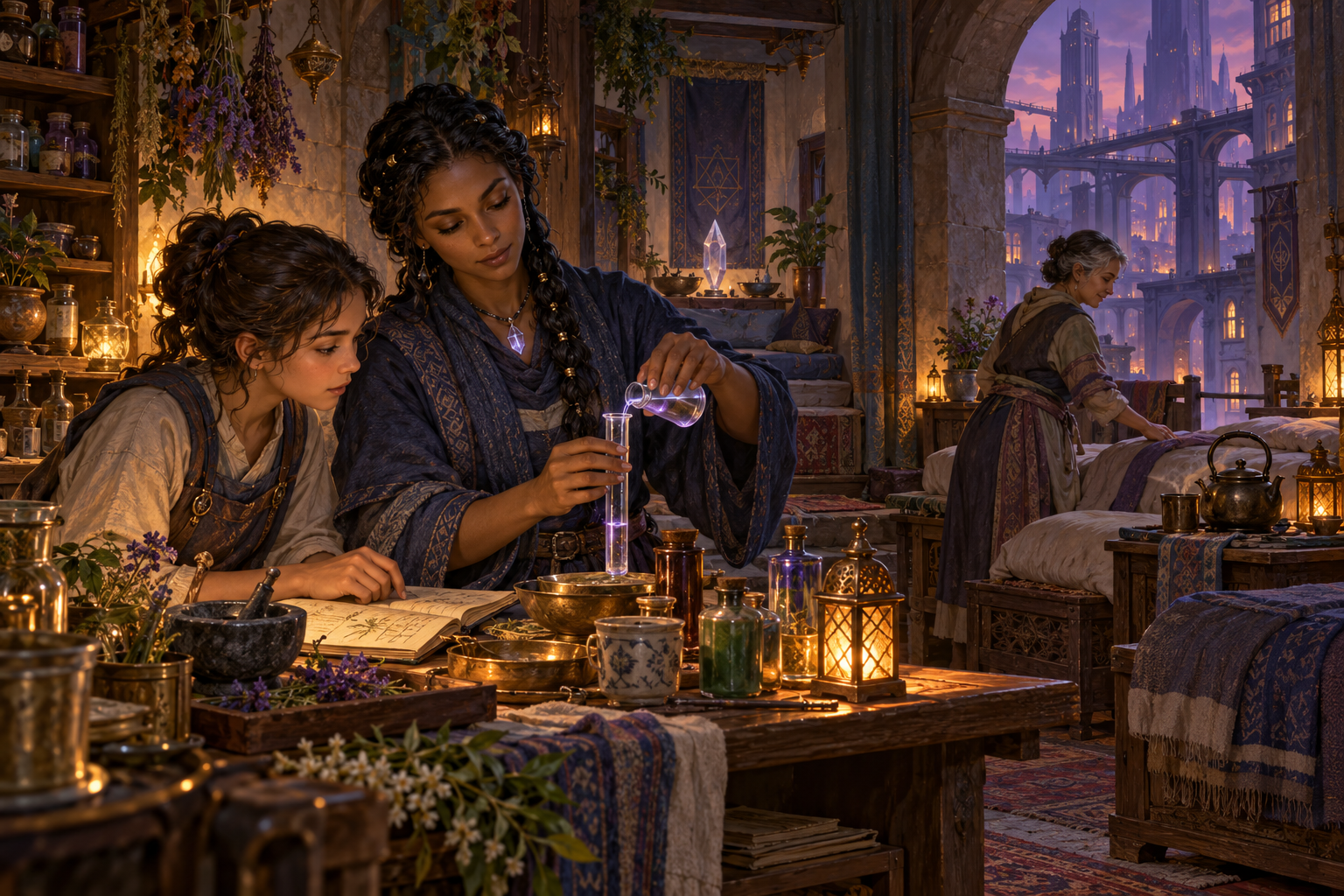
A kalashtar alchemist teaches attentive practical care in a neighborhood room.
Kalashtar are a people whose inheritance joins mortal lives with quori, spirits native to Dal Quor, the realm of dreams. Their origins lie in Adar on Sarlona, far across the sea from Sharn. Each individual is a person with their own mind and history, while their spiritual lineage carries something older than that individual life.
Ordinary dreamers touch Dal Quor in their sleep. Kalashtar experience something different: their dreams draw on their own subconscious and the memories of their linked quori, without taking them into Dal Quor. The bond can appear as intuition, emotional impressions, or visions. Most experience their spirit through those influences rather than a voice with whom they can hold a casual conversation.
The Path of Light
Many kalashtar follow the Path of Light, a faith concerned with spiritual discipline, compassion, and bringing about a better future. Practice can include contemplation and work that helps others. Faith is an active commitment for some and a more distant family inheritance for others; kalashtar communities contain disagreements and changes of belief like any other.
Kalashtar in Sharn
 Art: Andrea de Dominicis. Image source and credits, Eberron Wiki.

A Sharn-born kalashtar may know Adar through family, lessons, and community rather than travel. A household can preserve its spiritual inheritance while participating in the ordinary life of a Brelish neighborhood. Occupation and class remain powerful influences: a comfortable professional and a tenant sharing a message room have different room to act on the same conviction.
In 1250, the city’s religious communities provide places for mutual help as well as worship, often under material pressure. Spiritual work and practical work meet in shelter, food, teaching, and care. A kalashtar’s commitments can take shape in those small acts as readily as in a dramatic encounter.
The connection between mortal thought and a spirit of dreams also helps explain the prominence of psionic traditions among kalashtar: disciplines of the mind expressed through training and inherited potential. A community can preserve those practices alongside ordinary education and trades.
Background: Kalashtar; Dreams and Quori.
Lineage and individuality
A quori bond can be shared across a lineage. Distant relatives may recognize a familiar expression or emotional pattern without sharing each other's memories. The spirit's influence runs beneath daily thought; it does not stand beside every descendant giving spoken instructions.
A person raised outside a kalashtar community may understand those impressions gradually. A remembered dream can feel older than the dreamer, and an inherited instinct can arrive without explanation. Community teaching can help place those experiences without deciding what the individual must do with them.
A voice without sound
Kalashtar can communicate through the mind, a gift with practical uses in a noisy city. Telepathy still involves people deciding what to say and whom to trust. It does not make another person's unspoken thoughts public property.
An assertive musician, a patient healer, and an angry organizer can all be kalashtar. Commitment to compassion can coexist with disagreement about when restraint protects a community and when it abandons one.
Additional references: Exploring Eberron, printed page 41; Eberron: Forge of the Artificer, supplied PDF page 43.
Sources & adaptation
- Wayfinder’s Guide to Eberron — Ch. 3: Kalashtar