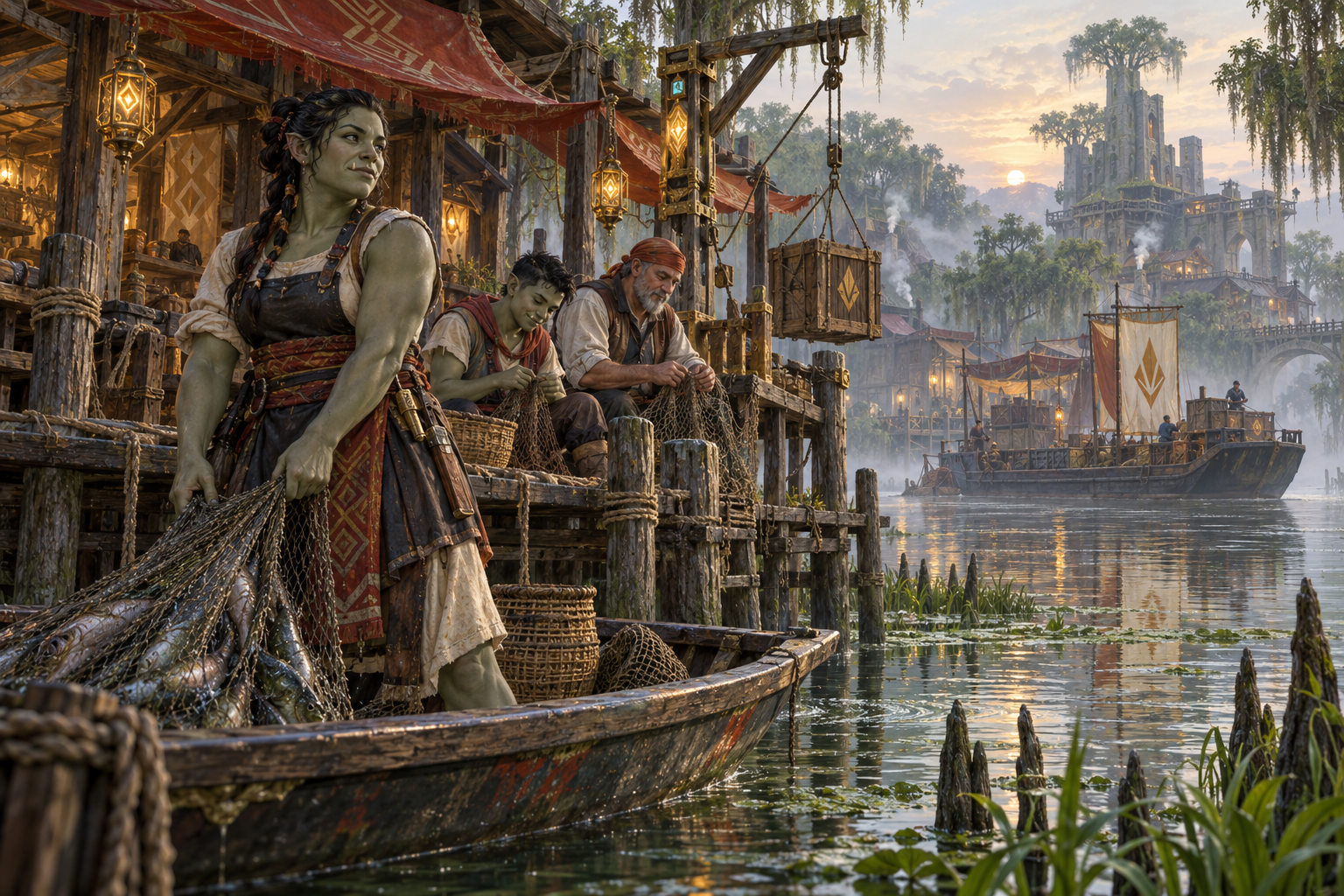
Marcher fishers mend nets beside a wetland landing reached by modern trade.
Orcs are among Khorvaire’s ancient peoples. Their histories include the Shadow Marches in the west and distinct cultures elsewhere on the continent. The Marches have long included communities shaped by both orc and human ancestry. Half-orcs can belong to generations of shared family and custom, with a settled place in their community.
Faith and homeland
The Gatekeepers are an ancient druidic tradition with roots among orcs. Their work concerns preserving the world against dangerous extraplanar forces and maintaining safeguards inherited from earlier ages. The tradition is one part of orc history rather than a universal religion.
The Ghaash’kala, or Ghost Guardians, keep watch in the Labyrinth, the broken canyons separating the Demon Wastes from the wider continent. Their sacred duty is to contain the fiends and other horrors of the Wastes. Their traditions of the Binding Flame developed separately from the Church of the Silver Flame. Marcher family traditions, Gatekeeper duties, and that long vigil developed under very different pressures.
Finding a place in Sharn
 Art: Steve Prescott. Image source and credits, Eberron Wiki.

House Tharashk bears the Mark of Finding in human and half-orc lines. Its roots connect it to the Marches, and its work in prospecting and tracking has carried its influence well beyond them. Unmarked relatives and employees also sustain the House’s business.
For an orc or half-orc in Sharn, those connections can be close, distant, or irrelevant to daily life. A family might maintain relationships in the Marches, work for a House contractor, or have lived in the city for generations. In 1250, access to training, supplies, and certified work often follows institutional ties. Household and neighborhood networks provide other forms of support.
Background: Orcs and the Ghaash’kala; Marchers, Zil, and Borders.
Marcher kinship
The Shadow Marches contain long-established human, orc, and mixed families. In many Marcher communities, kinship and local tradition matter more than an outsider's attempt to sort everyone by appearance. A person can inherit a business, a religious obligation, or an attachment to a wetland through several lines of ancestry at once.
Marcher religious life is varied. The Gatekeepers' inherited safeguards are one tradition; other communities practice other faiths. The label “orc” does not establish that someone is a druid, and a Marcher accent does not identify a religion.
Beyond an employer's surname
Tharashk's expansion drew Marcher knowledge into prospecting, tracking, and long-distance commerce. A worker may value its opportunities while distrusting the attached contract. Someone with family in an extraction region can see the material cost of a shipment that reaches Sharn as a cleanly certified product. Other orcs and half-orcs have no Tharashk connection at all.
Sources & adaptation
- Dragonmarks: Orcs and the Ghaash’kala — Keith Baker — Orc cultures and Ghaash’kala
- IFAQ: Marchers, Zil, and Borders — Keith Baker — Marcher identities