
A shifter airship rigger watches the changing weather above Sharn.
Shifters are a people whose bodies and instincts carry a bestial aspect. During a brief shift, that aspect becomes more pronounced: features sharpen and physical gifts emerge. Their familiar association with lycanthropy has also made them the subject of fear and disputed origin stories. Shifters are distinct from people afflicted with a transforming, contagious curse.
An animal affinity can be important to a shifter’s experience without determining a whole personality. The same broad affinity can be expressed differently by people with different homes, occupations, and temperaments. A heightened sense or a physical habit belongs to a person living an ordinary social life as well as to someone facing danger.
Communities and inherited fear
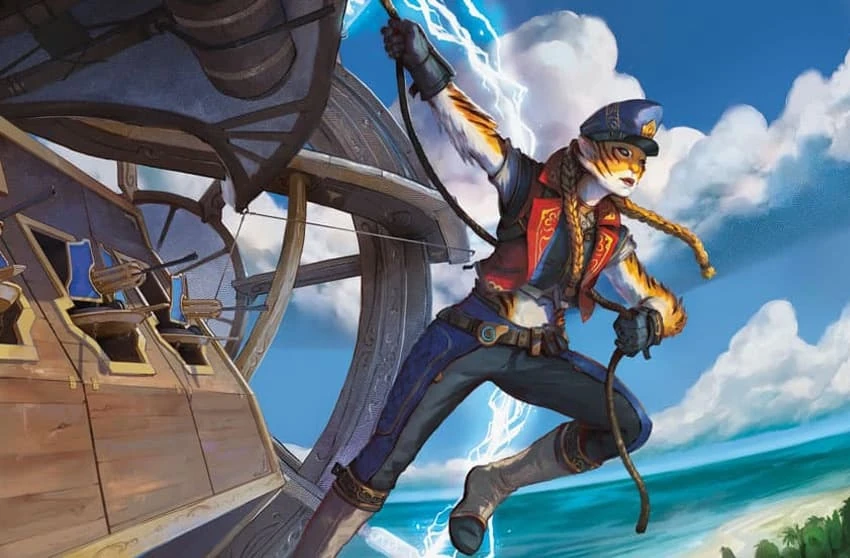 Art: John Thack. Image source and credits, Eberron Wiki.

Shifter communities include people living in the Eldeen Reaches and residents of Khorvaire’s towns and cities. Wilderness traditions are part of that range. A Sharn-born artisan or clerk can be shaped more immediately by a particular ward and household than by life in distant forests.
The Lycanthropic Purge remains a painful historical association. The battle against a genuine supernatural threat became entangled with persecution and suspicion of shifters. Memories of that harm have outlasted the people who committed it, with consequences for trust across communities and religious lines.
In Sharn in 1250, those inherited stories sit beside present concerns: work, housing, a reliable lift, and access to care. A shifter can belong to a faith, a House workplace, or a neighborhood organizing effort through convictions and experience. They share the city’s daily pressures with other residents while bringing their own histories to them.
Background: Changelings, Shifters and Lycanthropes.
The beast within
Shifter traditions often describe a beast within: a source of instinct, imagery, and self-understanding. The affinity is not another mind issuing orders. A wolf association might be understood through family loyalty, watchfulness, or a traditional story rather than a demand for aggression.
Common expressions of shifting emphasize endurance, fangs, speed, or alert senses. Appearance and animal affinity do not map neatly onto those gifts. Relatives can express their inheritance differently, and a person has a life beyond the brief moments when they shift.
Urban packs and older traditions
A pack can be an extended family or a close community formed through shared experience. Urban packs provide care, work contacts, and a place where familiar habits need no explanation. Membership need not mean living apart from other peoples.
Moonspeaker druids preserve traditions involving spirits and the natural world. Other shifters follow the Sovereign Host, Silver Flame, Blood of Vol, another faith, or none. A history of persecution makes those choices personal, without requiring every family to make the same choice.
Additional references: Exploring Eberron, printed page 44; Eberron: Forge of the Artificer, supplied PDF page 45.
Sources & adaptation
- Wayfinder’s Guide to Eberron — Ch. 3: Shifters