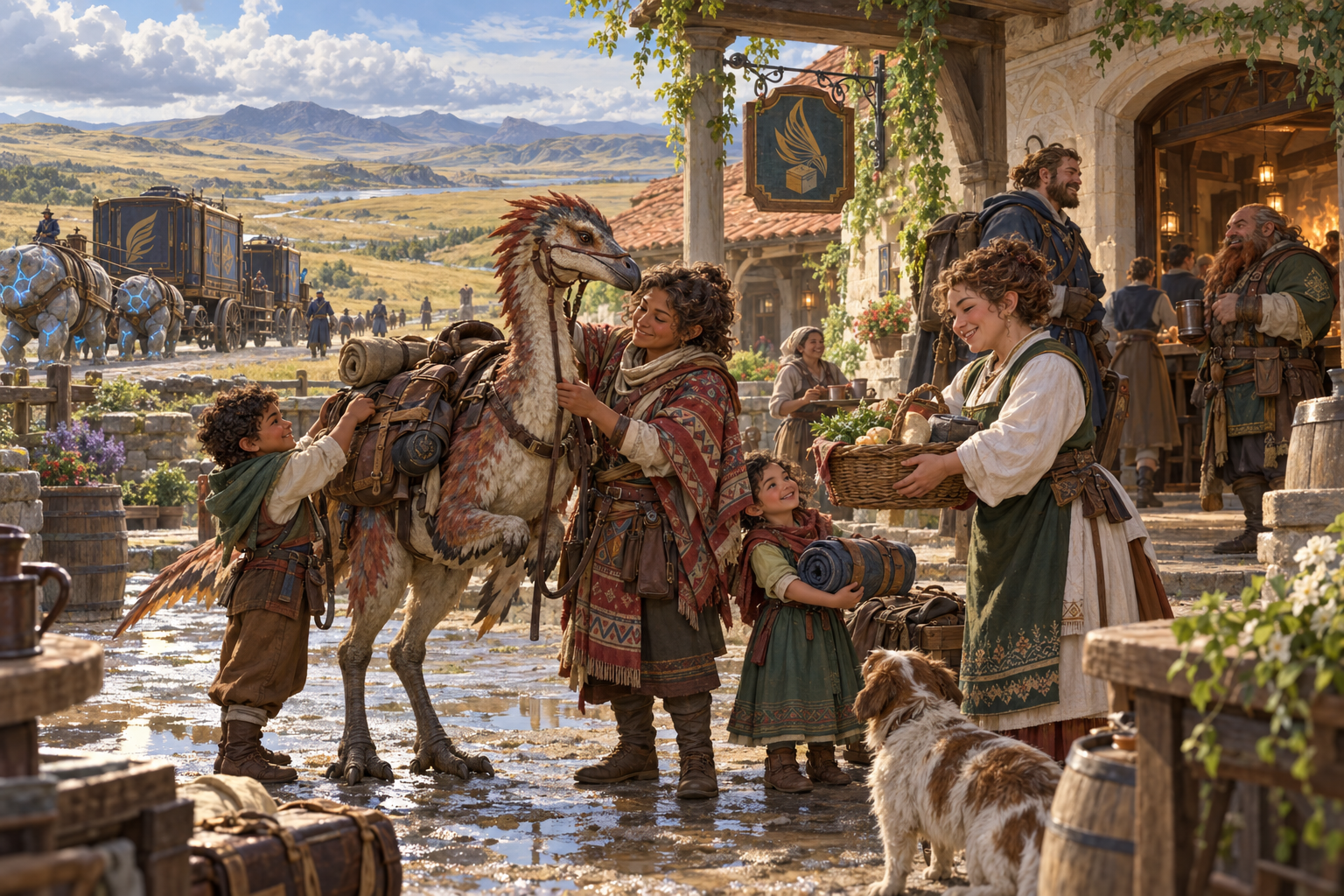
Talenta travelers and urban relatives share tea and supplies at a roadside inn.
Halfling cultures in Eberron range from the mobile communities of the Talenta Plains to households long established in Khorvaire’s cities. The Plains are associated with dinosaur mounts, extended family groups, and a way of life adapted to movement across open country. Urban halflings may keep close ties to those traditions, inherit only fragments of them, or know the Plains chiefly through relatives’ stories.
Talenta customs carry meaning in the communities that practice them. A mount can be a partner in daily survival, and family obligations can extend across distances that look empty on an urban map. City life creates different networks: a workplace, a neighborhood, or an institution can connect a family to people of many ancestries.
Two prominent Houses
 Art: Ron Lemen. Image source and credits, Eberron Wiki.

Halfling families carry two dragonmarks with an especially close connection to ordinary life. Jorasco bears the Mark of Healing and supplies medical services. Ghallanda bears the Mark of Hospitality and works in accommodation, food, and comfort. Their reach extends far beyond halfling communities; most customers and many employees come from elsewhere.
In Sharn in 1250, those institutions sit alongside independent healers, local inns, and congregations providing strained care and shelter. A halfling can depend on a Jorasco plan, oppose an employer’s conditions, or volunteer at a neighborhood meal without any contradiction between ancestry and conviction.
The Boromar Clan also has halfling roots, but it is a particular criminal organization. Its reputation and obligations belong to its members and associates. The broader halfling population includes people who fear it, profit from it, ignore it, or have no meaningful contact with it.
Background: Halflings.
Talenta inheritances
The Talenta Plains support distinct traditions of travel, kinship, and relationships with the land. Dinosaur mounts are part of a working life that includes hunting, carrying supplies, and moving a community across open country. A tribal identity, a family connection, and a companion animal can each carry obligations that a city visitor might overlook.
Halflings who move into urban life do not all maintain the same practices. Some preserve ceremonies and close Plains connections; others develop a blended family culture or have been city residents for generations. Clothing and occupation cannot tell a stranger how well someone knows the Plains.
Hospitality and power
An inn can offer safety, news, employment contacts, and a place to receive a letter. Those functions help explain why accommodation and food are powerful businesses. They also explain why a neighborhood kitchen matters when a commercial account fails. Traditions of care and welcome are broader than the institutions that sell those services.
Sources & adaptation
- Dragonmarks: Halflings — Keith Baker — Talenta and urban cultures