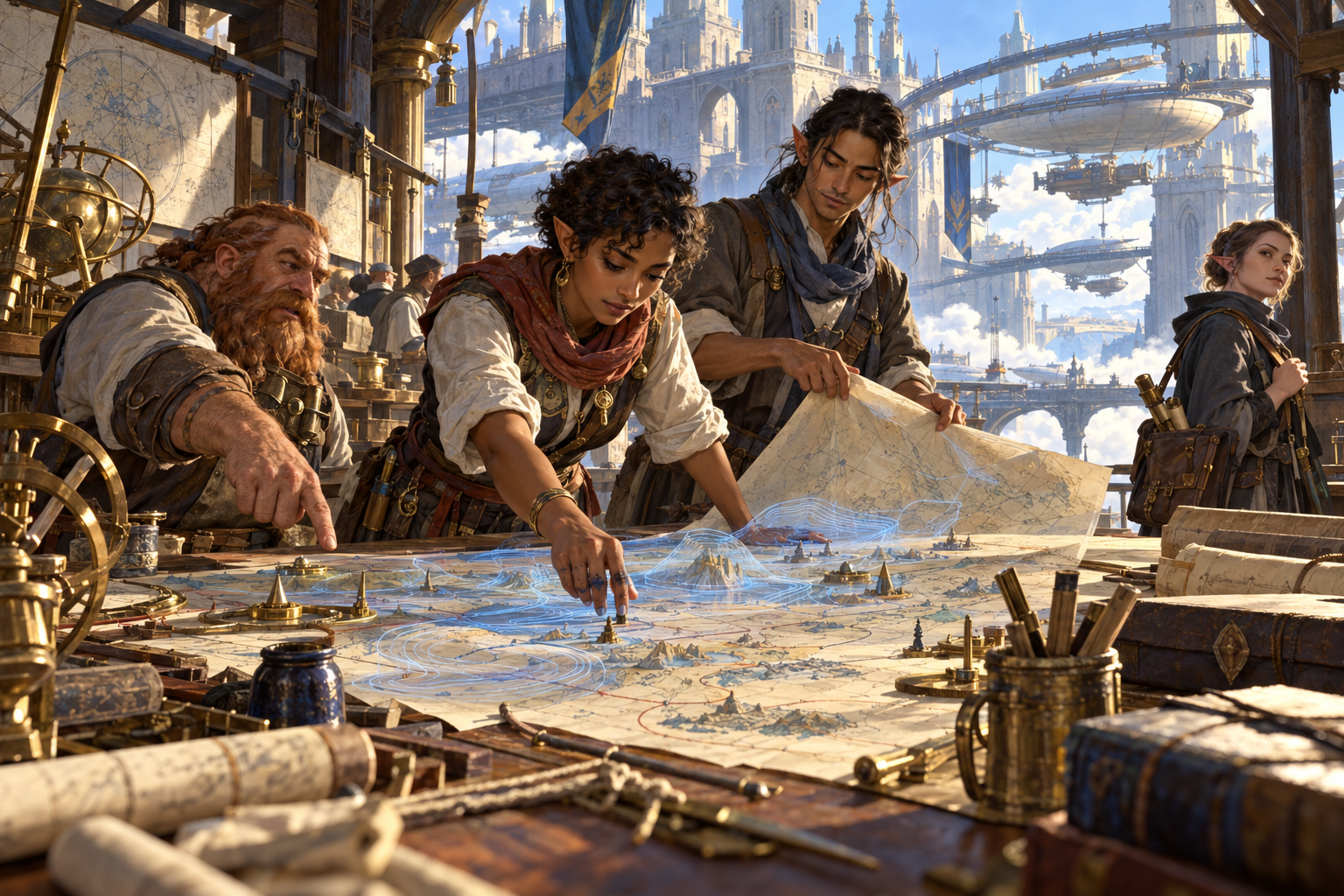
A Khoravar cartographer and coworkers plan routes above the airship docks.
Khoravar, often translated as “children of Khorvaire,” is a name many half-elves use for themselves. Their communities have existed for generations and developed traditions of their own. A Khoravar family can be descended from other Khoravar families on both sides; the term does not require a human parent and an elf parent in the most recent generation.
This identity grew within Khorvaire rather than arriving as a single transplanted culture from an overseas homeland. Family networks and a shared sense of belonging can connect people across national borders, while local citizenship and upbringing still matter. The distinction between a common inheritance and the habits of a particular household is familiar throughout Sharn.
Two marks, different businesses
 Art: Daarken. Image source and credits, Eberron Wiki.

House Medani carries the Mark of Detection, associated with warning and protective investigation. House Lyrandar carries the Mark of Storm, used in weather services and air and sea transport. Both Houses draw on Khoravar lineages, but they have separate businesses and interests. Most Khoravar belong to neither marked family.
In 1250, their services form part of the larger House economy. A Khoravar dockworker, investigator, tenant, or teacher occupies a different position from a marked heir with access to institutional training. House employment can bind salary, contacts, equipment, and housing together. A shared ancestry does not remove those differences in power.
Sharn also gives families many everyday ways to maintain ties: meals, work contacts, mutual help, and the simple knowledge of who can be trusted with a spare key. Khoravar identity can be a source of pride and connection within that life, alongside being Brelish, belonging to a faith, or owing a debt to a particular neighbor.
Background: Wayfinder’s Guide to Eberron.
The bridge between
A widespread Khoravar ideal describes their people as a bridge between communities. It can express itself through mediation, translation, music, or the less celebrated work of making sure two neighbors understand an agreement. Some connect that ideal to Thelanis, the plane of fey stories and enchantment, and seek a relationship between the everyday world and its stranger reflections.
That ideal is a cultural inheritance rather than an obligation to be agreeable. A mediator may decide that a contract is exploitative, or refuse to reconcile a victim with someone still harming them. Cooperation has meaning when the people involved can choose it.
Names and belonging
Khoravar is a people's name, not a fraction of a person. Some individuals still use “half-elf,” especially where it is familiar family language; others dislike being described through two supposedly complete peoples. Communities include generations of Khoravar relatives as well as people who discover that identity later.
Additional reference: Eberron: Forge of the Artificer, Khoravar, supplied PDF page 44.
Sources & adaptation
- Wayfinder’s Guide to Eberron — Ch. 3: Half-Elves; Ch. 4: Marks of Detection and Storm