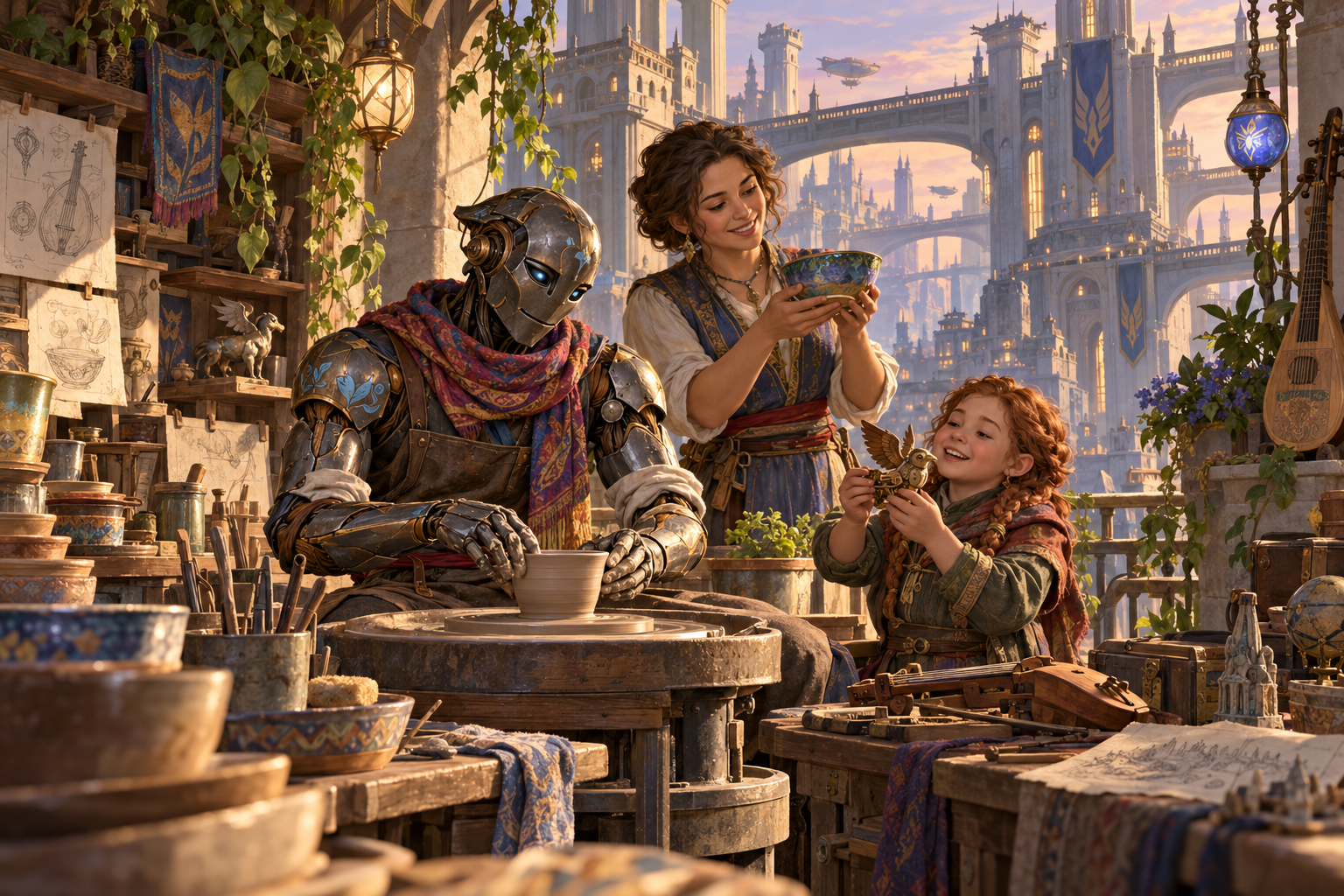
A free warforged artisan builds a life through personal craft and friendship.
Warforged are living people with crafted bodies. Woodlike fibers, metal, and alchemical materials form bodies that can be wounded and healed. A body made in a forge still belongs to the person who lives in it.
House Cannith created warforged for the Last War, making people for purposes chosen by others. Military orders, purchased labor, and the expectation of obedience shaped many early lives. Those beginnings left different marks: some embraced a soldier’s identity, some endured it, and others built an entirely different life afterward.
Freedom and the body
The Treaty of Thronehold recognized warforged freedom and banned creation forges in 996 YK. Legal personhood did not immediately provide housing, fair work, or a community willing to accept it. Choices about names, appearance, trade, and companionship became ways to build a life beyond an assigned function.
Warforged have unusual bodily needs. They need neither ordinary food nor breath, and their rest differs from sleep. Their durable bodies still require care. Integrated plating and tools can be personal parts of the body, with modification carrying a meaning quite different from changing a coat.
Two centuries later
 Art: Ignacio Bazan-Lazcano. Image source and credits, Eberron Wiki.

In 1250, an older warforged veteran may remember the Last War and the long growth of House influence firsthand. The years have allowed trades, friendships, convictions, and communities to develop far beyond the battlefield. An old military designation can survive beside a chosen name; an old demand for obedience can survive inside a supposedly modern workplace.
Warforged remain legally free. Enrollment in the Mana Standard uses a suitable personal trace rather than blood. Employers and officials still sometimes treat a worker’s body as an industrial asset, bringing legal freedom into conflict with institutional habits.
Stewards occupy a different and publicly controversial place in the city’s penal system. A free warforged neighbor, veteran, or colleague has their own life and rights, independent of that institution.
Background: The Warforged.
Design and chosen work
Some warforged were soldiers; others served civilian institutions or specialized purposes during the Last War. Training and an assigned role could provide a starting point without setting a limit on a person's future. A guard can become a scholar, a laborer can become a musician, and a body designed for strength can learn delicate work.
A repaired joint, decorative plating, a painted face, or a carefully chosen voice can carry personal meaning. Some prefer to preserve an old design, including marks others would hide. Decisions about that body belong to its owner.
Rest, care, and companionship
Warforged can remain conscious through the motionless rest their bodies require. Shared night watches can become an ordinary part of a household's rhythm. Resilience changes bodily needs; it does not remove pain, affection, or the need for skilled care after injury.
Origin in a creation forge does not provide a settled answer to every question about the soul. Faiths and scholars disagree, and warforged themselves hold different beliefs. Personhood does not depend on winning that argument.
Additional references: Exploring Eberron, printed page 46; Eberron: Forge of the Artificer, supplied PDF page 46.
Sources & adaptation
- Mana Standard Player Primer — PDF pages 2-7, campaign-era additions
- Rising From The Last War: The Warforged — Keith Baker — Identity, living construction, and postwar life