
An atlas, a traveler's belongings, and a view toward the wider world from Sharn.
Eberron is a world of ancient ruins, everyday magic, competing nations, and people trying to make a living between them. A lamplighter can know one useful spell while a great wizard remains a figure of legend. Lightning rail routes and message stations connect distant cities, but a missed fare or unpaid account still leaves someone stranded.
The world around Sharn
Most people in Sharn have their closest ties to Khorvaire, the continent shown in the regional orientation guide. Sharn belongs to Breland, one of the lands once united as Galifar. The other lands of the old kingdom were Aundair, Thrane, Karrnath, and Cyre. Their struggle over the succession became the Last War. Cyre was devastated by the Mourning in 994 YK; nobody has established its cause.
YK means Year of the Kingdom, the calendar counted from Galifar's founding. Mana Standard takes place in 1250 YK, more than two centuries after the war ended in 996. The war survives in law, borders, inherited loyalties, and the memories of long-lived people.
Magic and power
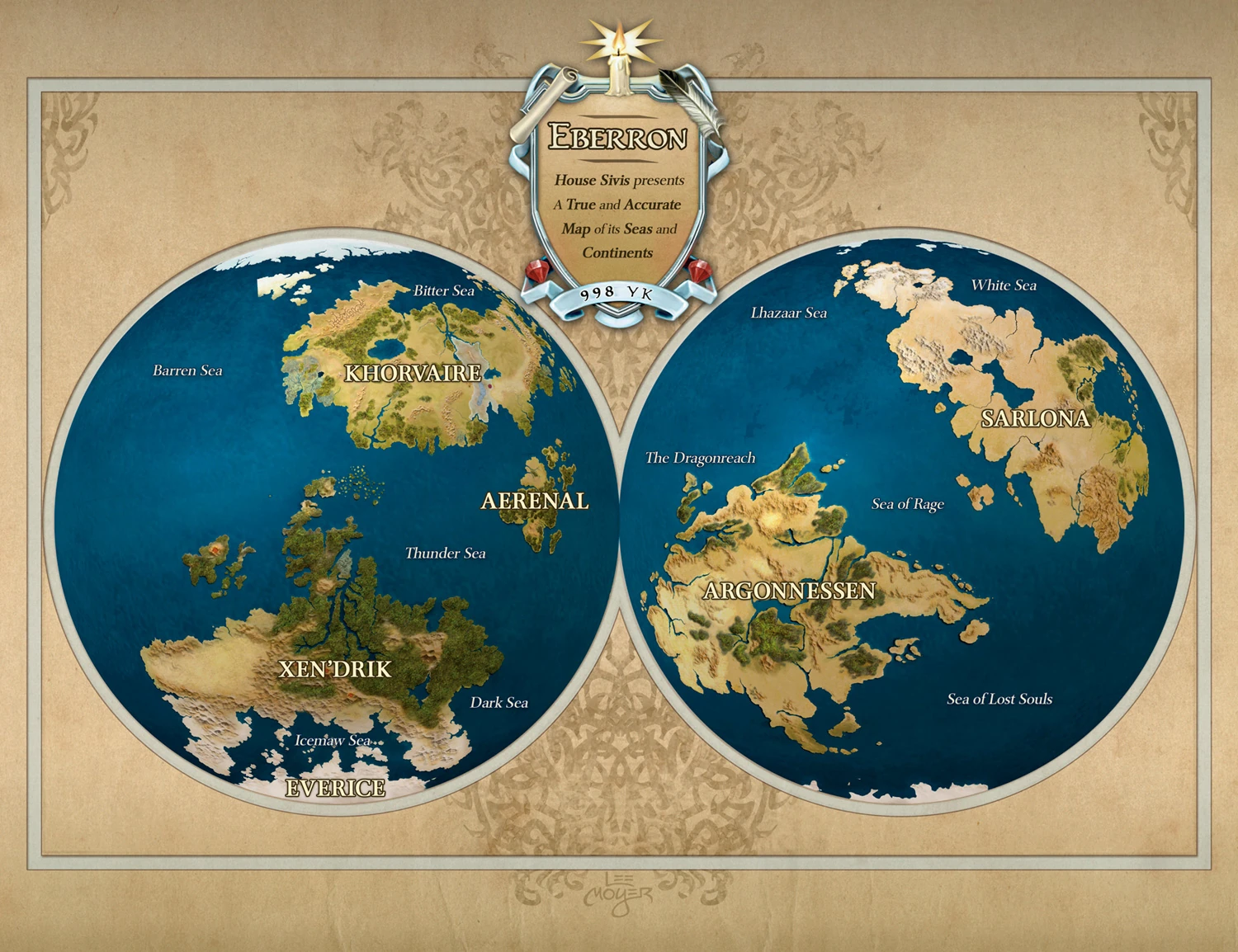 Art: Lee Moyer. Image source and credits, Eberron Wiki. Historical map.

The dragonmarked Houses are extended families and commercial institutions whose inherited marks support specialized magical services. Their reach crosses national borders. They are central to transport, communications, manufacturing, and care; a House employee can be an ordinary wage earner even when the institution has enormous power.
In Mana Standard, these services have become entangled with identity credentials, housing, and long contracts. The campaign chronology follows that later development. Small magic is abundant, access is unequal, and people still need workers to make and maintain the things they depend on.
Sharn brings many peoples and cultures together. Ancestry, citizenship, faith, and employer are different parts of a person's life. A shared ancestry does not guarantee a shared allegiance. Daily magic and Sharn explain what that world looks like at street level.
Planes, faith, and uncertainty
The world touches thirteen planes, other realities associated with forces such as dreams, war, fire, or peace. They are not distant countries or planets that a traveler can reach by an ordinary ship. A manifest zone is a place where one plane's influence is especially strong. Sharn's link to Syrania, a plane associated with peace and the sky, helps its towers and flying transport work.
Faith and planar knowledge answer different questions. A priest can heal and a scholar can study a manifest zone while still disagreeing about the gods' nature or the fate of a soul. Eberron's faiths include the Sovereign Host, the Silver Flame, and traditions centered on ancestors or the potential within mortal life. The cause of the Mourning and the ultimate truth of religious claims remain unknown.
Sources: Keith Baker on the planes; Eberron: Rising from the Last War.
Sources & adaptation
- Dragonmarks: Common Knowledge — Keith Baker — Common knowledge and perspective
- Mana Standard Player Primer — PDF pages 2-7, campaign-era additions
- Wayfinder’s Guide to Eberron — Ch. 1: What Is Eberron?