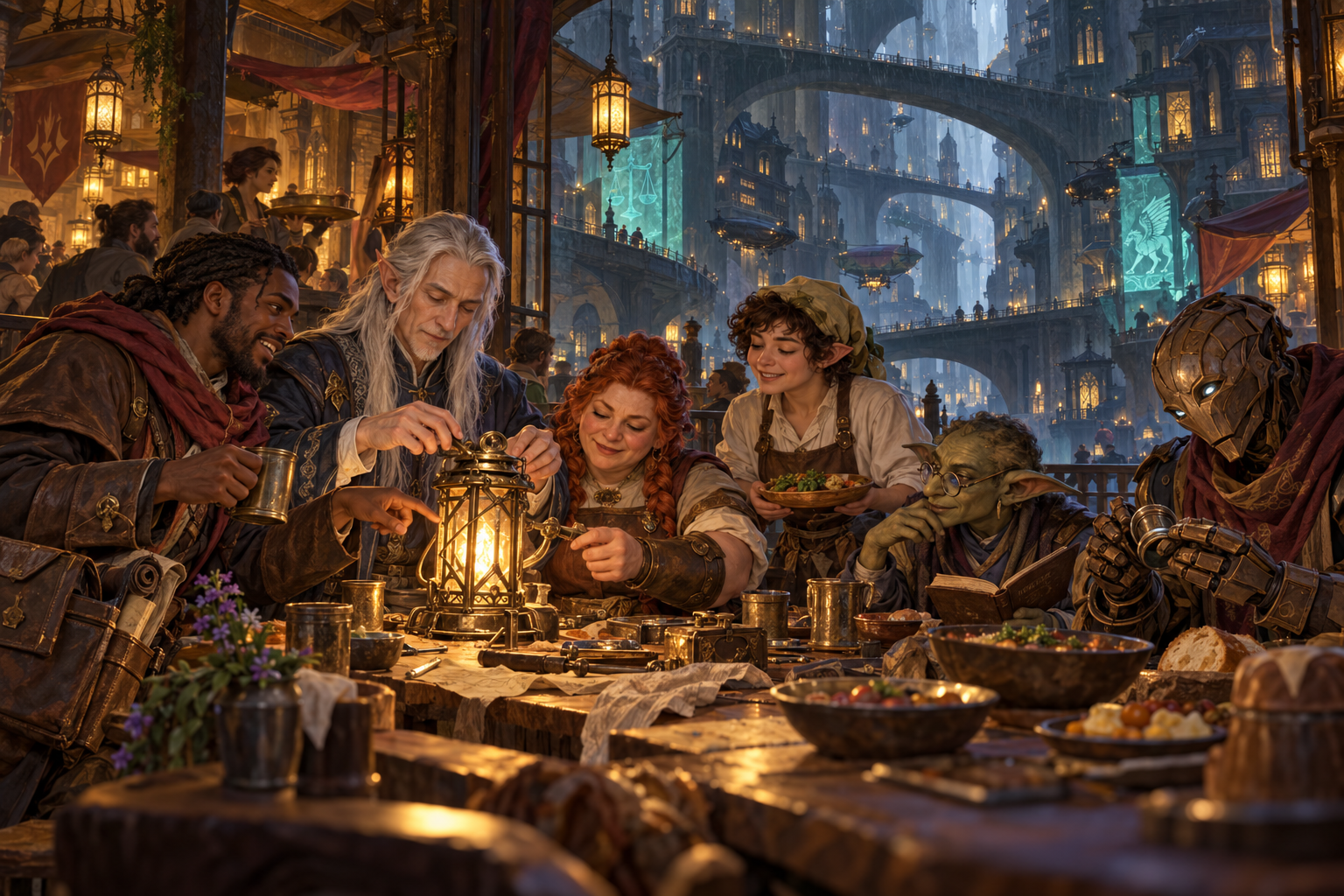
Neighbors of many peoples exchange food, tools, and stories at an independent tavern opening onto a rainlit Sharn bridge.
Sharn is a city of many peoples and overlapping histories. A landing can be home to families who have lived there for generations, recent arrivals from elsewhere in Breland, and people whose relatives still call another country home. Ancestry, citizenship, language, religion, and occupation describe different parts of a life. A Brelish elf and a Brelish human may share more daily customs than either shares with a distant relative.
The old kingdom of Galifar brought many communities into a common political order without making them one culture. The Last War broke that kingdom apart. In 1250 YK its consequences remain in institutions, family histories, memorials, and the recollections of long-lived residents. For some households, the war is an ancestor’s story; for others, someone at the table remembers it.
Peoples of the city
Humans, dwarves, elves, Khoravar, halflings, and gnomes all have communities spread well beyond the lands most closely associated with them. Orcs and half-orcs, goblins, hobgoblins, and bugbears belong to Khorvaire’s long history as well as its present. Changelings, shifters, kalashtar, and warforged bring other experiences of identity, inheritance, and the body.
Belonging in 1250
 Art: Wayne Reynolds. Image source and credits, Eberron Wiki. Adventurers of Eberron.

The dragonmarked Houses connect particular inherited marks to powerful businesses. Most residents are unmarked, and House offices depend on workers from many backgrounds. A House surname can offer training and access while tying a person’s livelihood to obligations they did not choose.
The Mana Standard promises a common way to identify customers. Its conveniences reach different bodies unevenly: warforged use a suitable personal trace, while changelings can lose access when routine checks reject a change of appearance. Beyond those counters, neighbors build belonging through shared work, meals, care, and loyalty. Lives and Loyalties follows those connections into everyday life.
Setting background: Keith Baker, Common Knowledge; Wayfinder’s Guide, peoples and cultures.
More neighbors and travelers
Dragonborn bring histories that include Q'barra's older communities. Tieflings and aasimar live with supernatural inheritances whose meanings vary between families and faiths. Gnolls include people connected to Droaam's Znir Pact and people with different lives entirely.
Drow preserve several distinct cultural inheritances associated with Xen'drik. Lizardfolk include communities in Q'barra and Xen'drik as well as people whose lives take them elsewhere.
Goblins, hobgoblins, and bugbears have individual profiles alongside the goblinoids overview. This list does not exhaust the city's residents. Travelers and established families have roots elsewhere in a much larger world.
Ancestry, culture, and a character's life
Ancestry describes part of a body and inheritance. Culture grows through language, family, education, faith, and repeated practice. Citizenship and employer are different relationships again. A name or appearance cannot supply all of them at once.
The revised character rules use species for the mechanical choice and keep background and class separate. These cultural articles explain places and traditions; the rules library contains the traits and choices used on a sheet. A 1250 YK character can inherit an old tradition while living a life its founders would scarcely recognize.
Sources & adaptation
- Dragonmarks: Common Knowledge — Keith Baker — Perspectives and common knowledge
- Wayfinder’s Guide to Eberron — Ch. 3: Races of Eberron