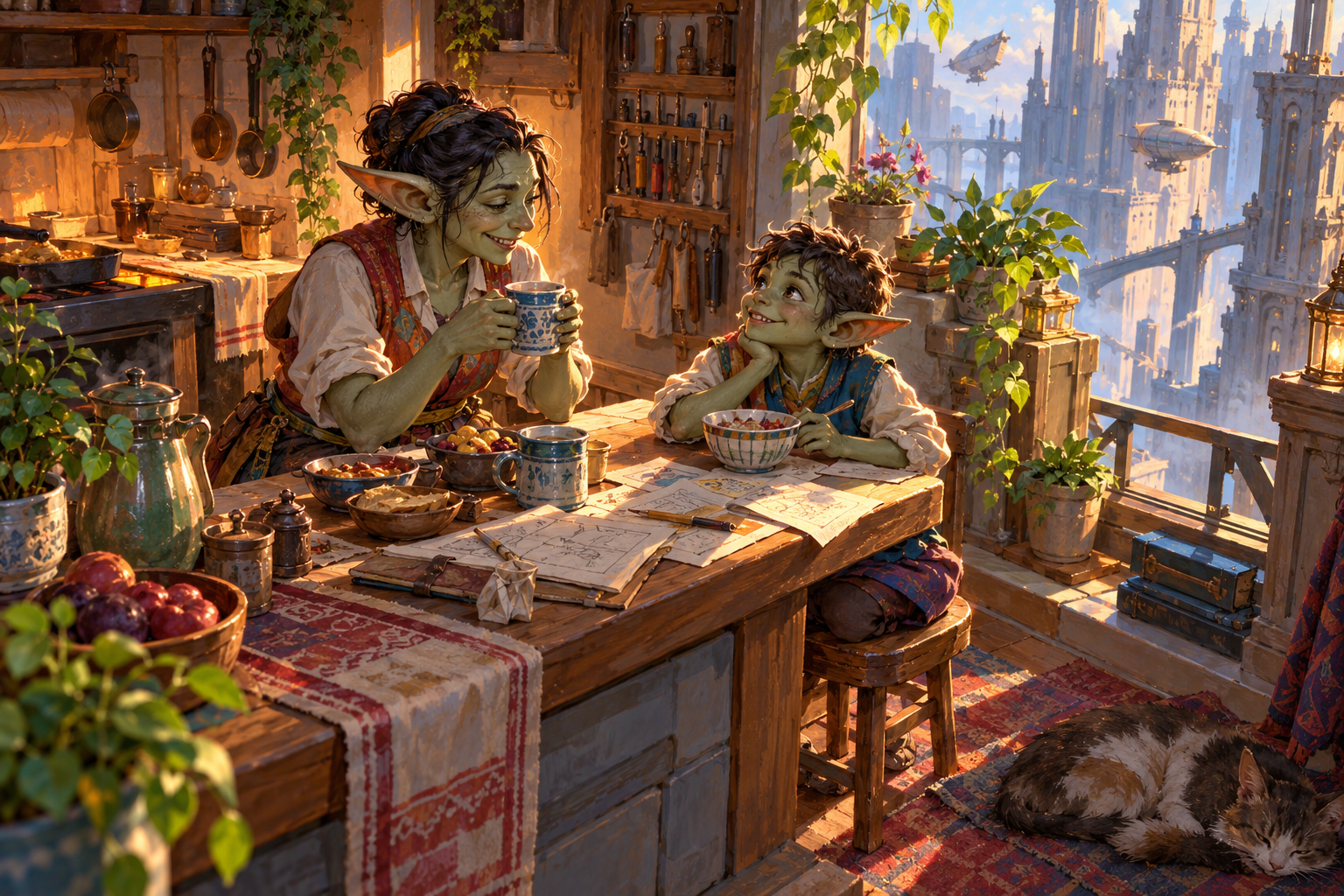
A goblin parent and child share breakfast at a table adapted to their household.
Goblins are one of Khorvaire's oldest peoples. Their history reaches beyond the roles later kingdoms assigned them. Sharn stands on the remains of Ja'Shaarat, an ancient goblinoid city, and goblin families belong to the modern city's life as residents rather than visitors to somebody else's homeland.
Families, culture, and work
A Sharn-born goblin, a Darguul traveler, and someone raised in a Dhakaani community can share a language while holding different expectations of authority, family, and public life. Goblinoid history explains the distinction between those inheritances.
Dhakaani traditions call goblins golin'dar and value their skilled labor alongside the work of hobgoblin and bugbear companions. Craftspeople, healers, scouts, and other specialists contributed to the empire. Modern lives extend beyond that framework: a clerk, performer, repairer, or schoolchild need not identify with an imperial past.
A place in Sharn
Small stature changes how a city built for many bodies is used. A workbench, stair, crowded lift, or piece of equipment may be convenient for one customer and awkward for another. Practical adaptations are ordinary features of households and workshops.
Goblins share Sharn's pressures of rent, certification, and access to care. Their closest connections may be to a landing, workplace, congregation, or relatives elsewhere. Bugbears and hobgoblins share parts of that older history without defining an individual goblin's obligations.
References: Eberron: Rising from the Last War, Goblinoids, printed pages 24–26; Exploring Eberron, The Heirs of Dhakaan, printed pages 99–100.