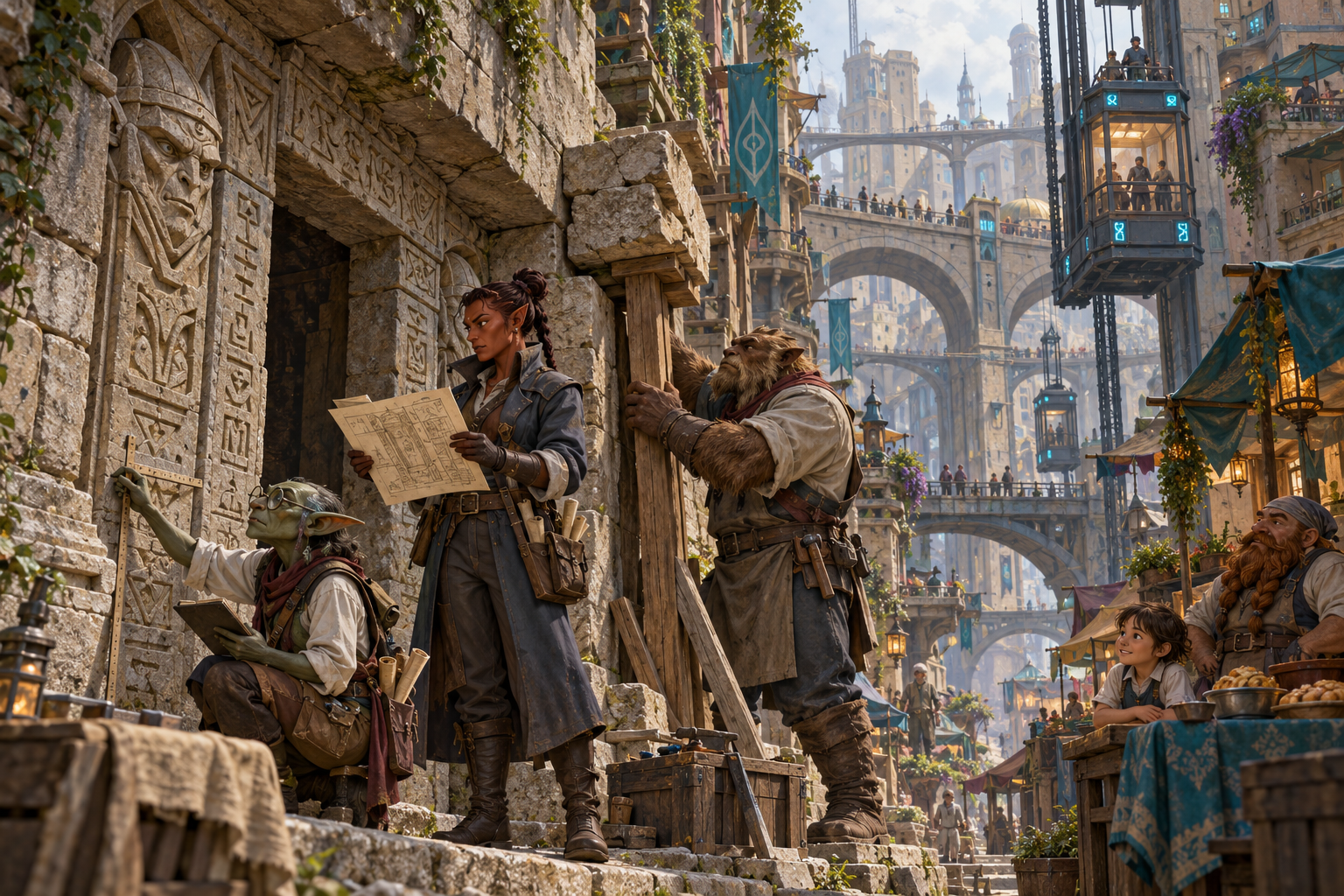
Goblinoid residents care for an older carved doorway beneath modern Sharn.
Goblins, hobgoblins, and bugbears have lived in Khorvaire since long before human settlement. Their histories include the empire of Dhakaan, later communities formed after its collapse, and modern urban and national identities. The remains of earlier civilizations are part of the continent beneath the familiar map of the Five Nations.
Dhakaan and its descendants
Dhakaan was a sophisticated empire with its own arts, military traditions, and social order. An invasion by the daelkyr—alien powers associated with Xoriat, the Realm of Madness—shattered its society. The daelkyr were eventually bound, but Dhakaan’s damaged institutions continued to unravel. Its collapse took place thousands of years before Galifar.
Dhakaani cultural traditions and later goblinoid communities followed different paths after the empire fell. The histories they kept, languages they used, and relationships they formed developed amid its aftermath and the rise of later kingdoms.
Darguun represents another political and cultural history, shaped by the upheavals of the Last War. “Darguul,” “Dhakaani,” and “goblin” describe different things: a national association, a cultural inheritance, and an ancestry.
Sharn’s older roots
 Art: Cory Trego-Erdner. Image source and credits, Eberron Wiki.

Sharn stands above layers of older settlement. Its goblinoid residents can belong to longstanding city communities as readily as to a family with ties elsewhere. A newcomer from Darguun and a Sharn-born goblin may share a language while approaching the city through very different experiences.
In 1250, neighborhood, work, and access to services cut across those backgrounds. Goblinoid residents deal with the same contracts, rent, and certification systems as their neighbors, with unequal resources for challenging an employer or official. A person’s body and the name outsiders give it say little about which institution has earned their trust.
Beneath modern Sharn are the remains of older cities, including the goblinoid settlement of Ja’Shaarat. Layers of construction can preserve the evidence of an earlier street or doorway beneath a later neighborhood. The city’s peoples inhabit a place with a much longer history than its current skyline suggests.
Three peoples, many communities
Goblins, hobgoblins, and bugbears each have a profile of their own. Their bodies and inherited gifts differ; their loyalties and cultures cannot be read from those differences. Sharn communities, the peoples of Darguun, and heirs to Dhakaani traditions have lived through different histories.
Dhakaani traditions use dar, “the people,” as a collective term. They place strong value on disciplined service, skilled work, and remembered deeds. Those ideals belong to a particular civilization. A goblin born in a Brelish tenement does not automatically share its institutions or remember an empire that fell thousands of years ago.
The people living closest to Sharn's ancient stonework may have little influence over what happens to it. A carved threshold can be a family landmark, a landlord's obstruction, and a scholar's evidence at once. Recovering an old street name is different from speaking for everyone now living there.
Additional cultural reference: Exploring Eberron, The Heirs of Dhakaan, printed pages 99–100.
Sources & adaptation
- Dragonmarks: Goblins — Keith Baker — Dhakaani and modern goblinoid identities