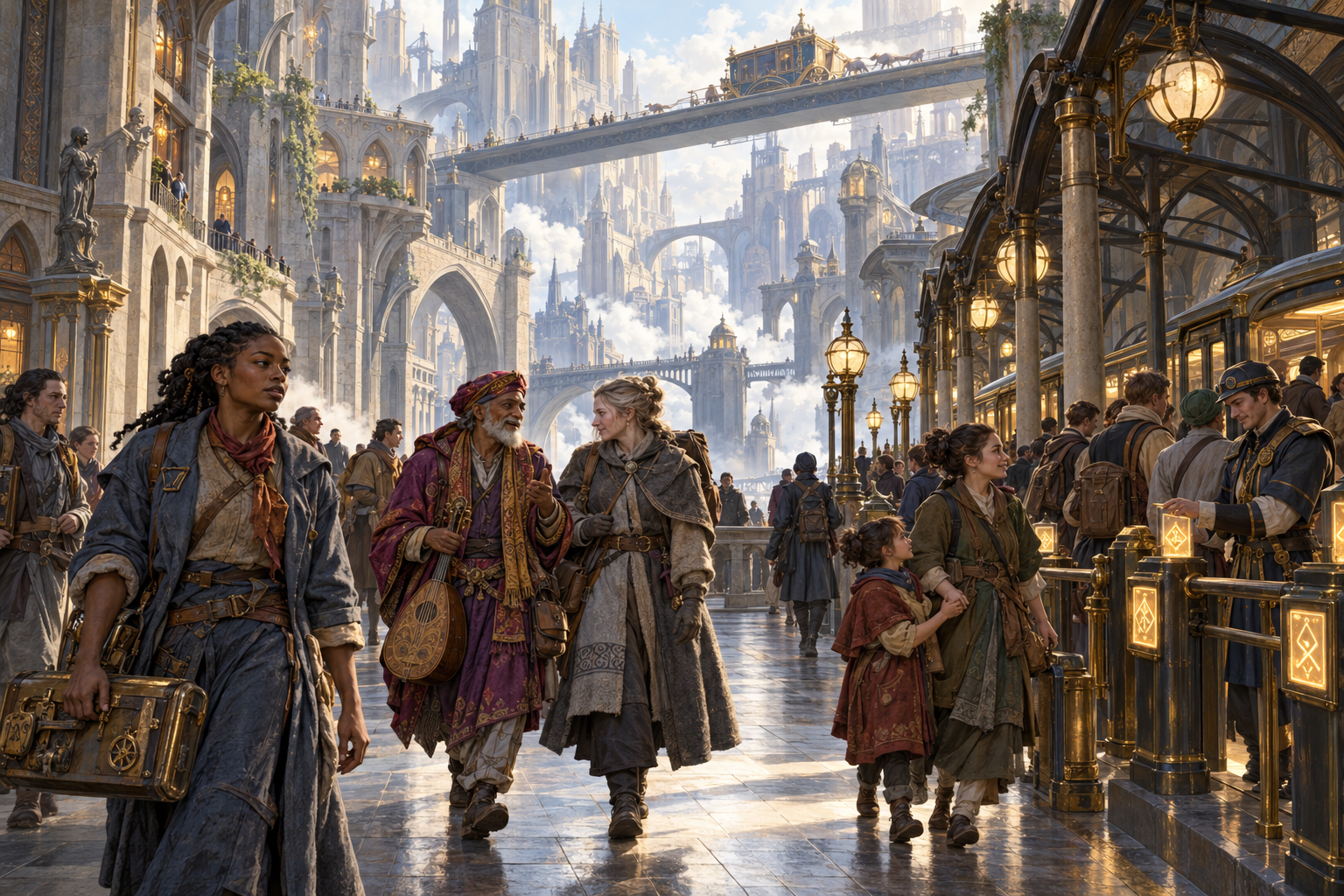
Human commuters, makers, and families cross a Sharn concourse beneath the city’s unequal tiers.
Human families in Khorvaire trace distant roots to Sarlona, across the sea. Successive migrations, settlement, and intermarriage produced a population with many appearances and regional identities. The peoples of the Five Nations share neither a single face nor a single account of their past. Accent, clothing, faith, and family connections often say more about someone’s upbringing than appearance does.
Galifar’s human dynasties helped shape the kingdom and its successor states, but those states were always home to many ancestries. “Brelish” is a national and cultural identity shared by humans and their neighbors. The same is true of the other Five Nations. A family can keep Cyran traditions generations after losing its ancestral home, or feel thoroughly Sharnish despite having relatives across several borders.
Families and institutions
 Art: David Bircham. Image source and credits, Eberron Wiki.

Human lineages bear the Marks of Making, Sentinel, Passage, and Handling, associated with Cannith, Deneith, Orien, and Vadalis. Some human families also carry Tharashk’s Mark of Finding. Those bloodlines account for a small portion of human life. Most people work without a dragonmark, including most of the workers whose labor keeps House services running.
In Sharn, human lives span the same divide in wealth and access as the rest of the city. A salaried employee with employer housing, an independent repairer, and a tenant sharing tools on a landing can live within sight of one another while facing very different choices. The Standard connects their accounts; it does not make their circumstances equal.
For most humans in 1250, the Last War belongs to inherited memory rather than personal recollection. Family stories can sit beside living witnesses from longer-lived peoples, keeping an old national argument uncomfortably close to home.
Background: People of the Five Nations.
Nations, households, and belief
Aundairian traditions place unusual value on arcane learning; Thrane is closely associated with the Silver Flame; Karrnath carries a strong military inheritance. Breland's crowded cities and varied countryside have their own local loyalties, while Cyran identity survives the loss of a homeland. These associations describe histories and institutions. They do not tell a stranger which religion a person follows.
Human adaptability is visible in households that hold several inheritances together: a Brelish citizen with Sarlonan grandparents, a family keeping a Cyran holiday, or a workshop where several languages are spoken. The place someone learned a trade and the people who vouched for them often matter more than a distant origin.
Mortality and memory
A human organizer can spend a lifetime building something an older elf remembers seeing founded. Apprenticeships, archives, memorials, and family stories carry knowledge beyond that short lifespan. The city also loses knowledge when a workshop closes or a neighborhood is displaced. Preserving a teacher's notes can be as important as preserving an heirloom.
Sources & adaptation
- Wayfinder’s Guide to Eberron — Ch. 3: Humans; Ch. 4: Dragonmarks