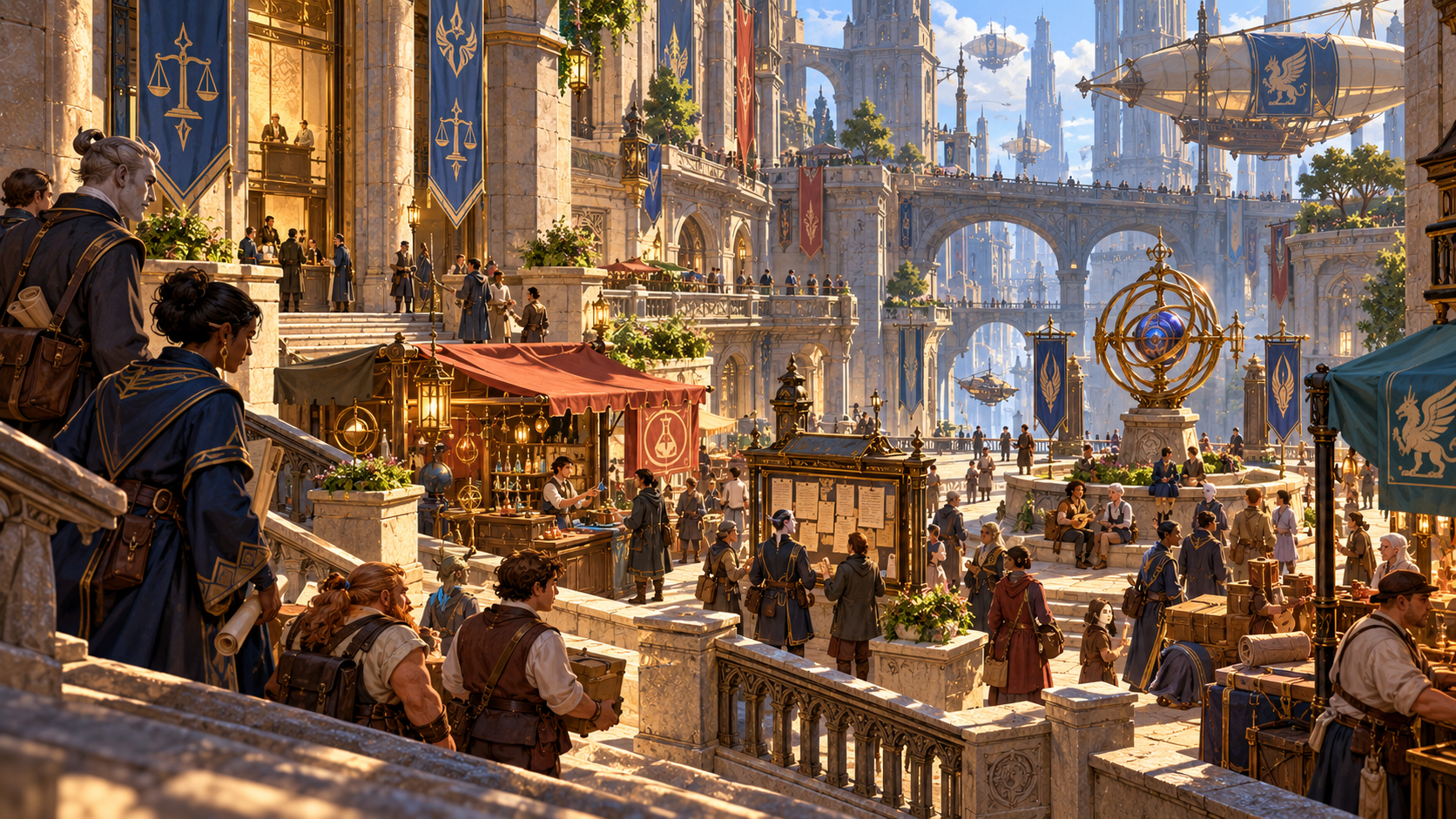
A public landing links civic offices, House services, independent shops, and a neighborhood notice table.
Power in Sharn runs through public offices, employers, wealthy patrons, criminal networks, and neighborhood relationships. One person can depend on several of these at once: a House employee may rent from an independent landlord, worship at a local shrine, and owe a favor to someone who helped a relative.
The main names
| Group | What the name usually means |
|---|---|
| Dragonmarked Houses | Commercial institutions controlling specialized magical services and extensive employment networks |
| Civic authority | The elected council, Watch, courts, and the broader Brelish government |
| Boromar Clan | A longstanding crime family with halfling roots and historical connections to gambling, smuggling, and influence |
| Daask | A criminal network historically known for intimidation and conflict with established Sharn rivals |
| House Tarkanan | A local organization associated with aberrant dragonmarks, outside the recognized commercial Houses |
| Aurum | An association of wealthy people whose social connections can become business and political influence |
Belonging and dependence
An employee, customer, relative, willing participant, and person being coerced can all have ties to the same organization. Those ties carry different choices and risks. A worker's House uniform does not explain their politics, and a threatened shopkeeper is not an enforcer simply because money changes hands.
Sharn also has tenant networks, repair circles, religious communities, and people organizing around shared problems. In 1250, resistance is local and varied. House Tarkanan is one distinct force; labor and tenant organizing do not answer to a single citywide commander.
Resistance networks
Sharn's resistance groups share particular dangers without sharing one program.
| Group | Where its opposition begins | Work a resident might encounter |
|---|---|---|
| The Voice | Steward sentencing and the treatment of sentient life as a House asset | Vigils, witness support, disputed-case records, and pressure on Steward contractors |
| The Unclaimed | Warforged personhood and the right to control one's body and work | Escorts, safe lodging, trusted repairs, and challenges to claims of ownership |
| The Landing Compact | Household dependence on employers, landlords, and certified providers | Tenant advocacy, strike funds, shared tools, and independent neighborhood services |
| The Free Weave | Restrictions on magical study, repair, and independent use | Teaching, shared repair knowledge, and assistance attributed to a concealed network |
The Free Weave name is associated with quiet assistance. A repairer or tutor is not necessarily a member, and receiving help does not establish who is connected to whom.
Members sometimes cooperate around a witness, family, or shipment. They also disagree about public exposure, bargaining, sabotage, and who will bear the consequences. A connection to one does not make someone welcome in every other cell.
Rival interests
The Houses maintain open peace for customers while competing over contracts and influence. Public agreement can coexist with litigation and fierce commercial rivalry. For residents, choosing between competing providers may still mean dealing with the same framework of credentials and authorizations.
The Standard and Weavegrid explains that framework. Life on the landings shows the smaller relationships that keep neighborhoods functioning alongside it.
Sources & adaptation
- Eberron: Rising from the Last War — Ch. 3: Criminal Activities; Ch. 4: Group Patrons
- Mana Standard Player Primer — PDF pages 2-7, campaign-era additions
- Organized Crime — Manifest Zone — Topics and organizations